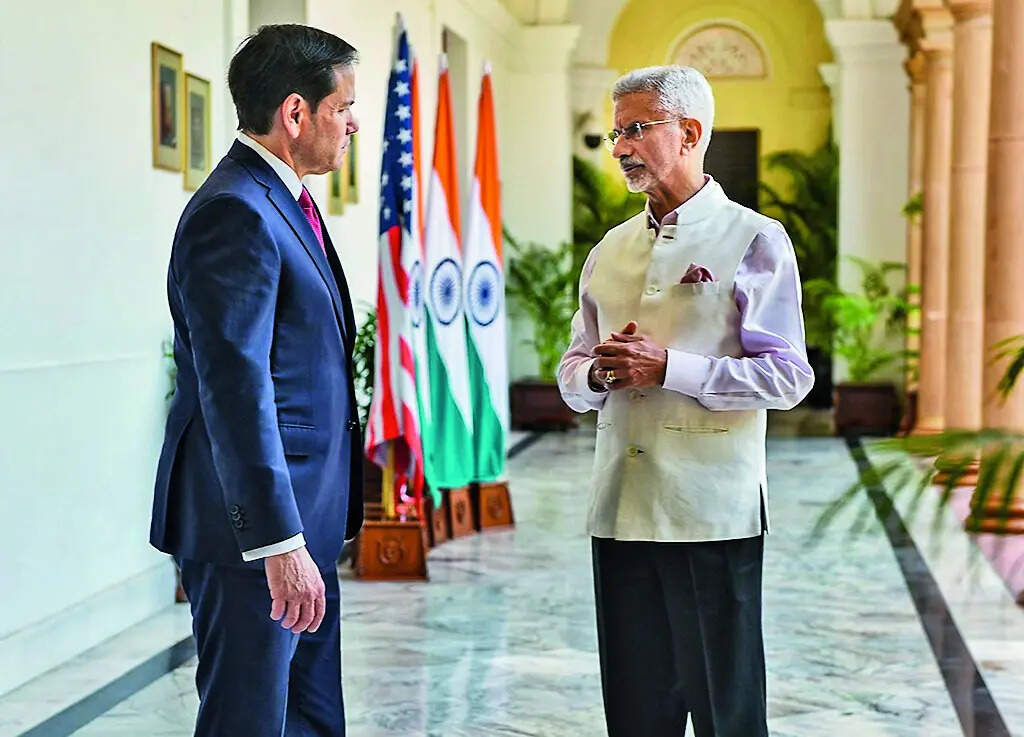
External Affairs Minister S Jaishankar and US Secretary of State Marco Rubio held their first bilateral meeting in New Delhi on Friday, aiming to revitalise the India-US strategic partnership after a year marked by friction over trade, visas and energy sourcing. The talks, reported by *The Times of India*’s Sachin Parashar, covered a wide range of issues including energy security, defence cooperation, critical minerals supply chains, trade negotiations, counterterrorism and regional stability in West Asia.
Jaishankar raised concerns over visa-related hurdles faced by Indian professionals, students and business travellers, linking these challenges directly to the health of technology, research and business cooperation between the two nations. He emphasised that while both countries cooperate on managing illegal migration, India expects that legitimate mobility of people — essential for economic and technological exchanges — should not be adversely affected. In response, Rubio clarified that recent US visa and trade policies were not targeted at India and reflected broader global considerations rather than bilateral grievances. He expressed optimism that a US trade delegation would soon visit India to continue negotiations, signalling renewed momentum in trade talks.
On energy cooperation, Jaishankar underscored India’s strategy of diversifying its energy sources to ensure security, especially in light of regional instability such as tensions in the Strait of Hormuz. He described the US as a “significant and reliable” source of energy for India, alongside other partners. Jaishankar stressed that energy security must be pursued through diversification — “large, dependable and cheap” sources — rather than through market distortions or constraints. He also defended India’s energy ties with the US, asserting that the era calls for “de-risking” rather than dependence on any single supplier.
The two ministers also discussed cooperation in critical minerals, an area where China currently dominates. Jaishankar reiterated India’s opposition to the weaponisation of market shares and supply chains, underscoring the need for trusted partnerships and resilient supply chains to reduce global economic risks. This aligns with a broader push to reduce dependence on China-dominated supply networks in strategic sectors.
Jaishankar reiterated India’s support for dialogue, diplomacy and unimpeded maritime commerce in West Asia, while emphasising respect for international law and trusted partnerships. He also expressed India’s zero-tolerance stance on terrorism and thanked the US for its strong counterterrorism cooperation.
Regarding third-country mediation, when asked about Pakistan’s role in US-Iran peace talks, Jaishankar refrained from naming Pakistan directly, stating that such matters were for the involved parties to resolve. Rubio, in turn, assured that US ties with any country would not come at the expense of its strategic alliance with India. He acknowledged tactical cooperation with multiple nations but reaffirmed that the US-India partnership remained distinctive due to shared alignment on global challenges.
The meeting also touched upon nuclear cooperation. Jaishankar highlighted the recent passage of India’s SHANTI Act, which reforms the country’s nuclear energy sector and creates new opportunities for collaboration. He mentioned a recent visit by a US delegation to India and expressed hope that potential in nuclear energy cooperation could be realised in the near future.
Both leaders acknowledged that national interests guide their relationship, with areas of harmony and occasional divergence. They expressed commitment to managing differences constructively while building on convergences in defence, energy, trade and technology.