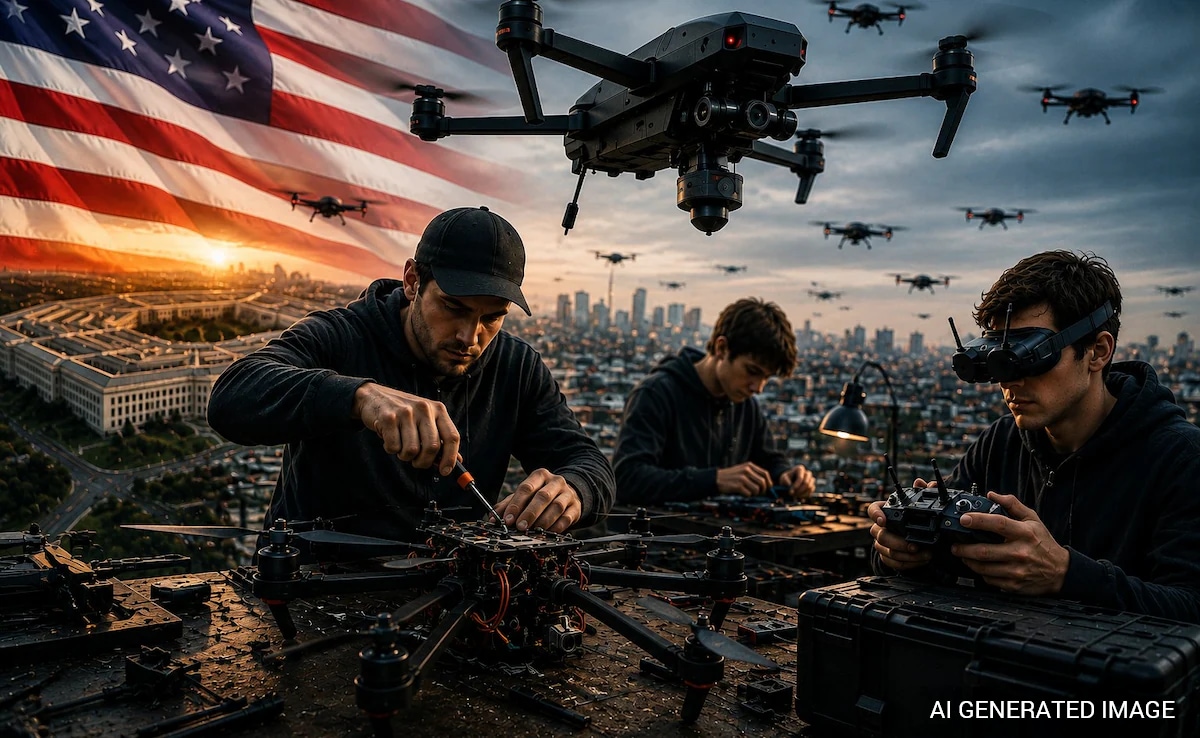
The United States Department of Defense (DoD) has initiated a landmark initiative worth $54 billion aimed at revolutionizing aerial warfare through large-scale drone swarms. Dubbed the "Drone Dominance" competition, the 18-month program seeks to identify and fast-track the most capable domestic manufacturers to produce thousands of autonomous and semi-autonomous unmanned aerial systems (UAS) capable of operating in coordinated swarms. These systems are envisioned not only for surveillance but primarily as precision-guided munitions, effectively transforming them into "flying bombs" designed for high-intensity combat scenarios.
According to defense officials familiar with the initiative, the project is part of a broader modernization push to counter evolving threats from near-peer adversaries such as China and Russia. The Pentagon has emphasized the need for rapid deployment, scalability, and networked lethality—where individual drones communicate and coordinate in real time to overwhelm enemy defenses. This strategy aligns with the U.S. military’s Joint All-Domain Command and Control (JADC2) framework, which integrates sensors, shooters, and platforms across air, land, sea, space, and cyberspace.
The program’s timeline is aggressive. The competition phase will run for 18 months, culminating in field demonstrations where finalist manufacturers will showcase their prototypes’ ability to deploy, coordinate, and engage targets autonomously. While specific companies have not been named, the Pentagon has indicated that both established defense contractors and emerging tech firms specializing in artificial intelligence, robotics, and swarm algorithms will be eligible to compete. Industry analysts suggest that firms like Boeing, Lockheed Martin, Northrop Grumman, and newer players in AI-driven autonomy—such as Anduril Industries and Skydio—are likely contenders.
Funding for the initiative is drawn from the Pentagon’s $842 billion fiscal year 2025 budget request, with $54 billion allocated specifically for drone swarm development and procurement. The scale of investment underscores the strategic priority placed on unmanned systems in future warfare. Critics, however, have raised concerns over ethical implications, cost overruns, and the potential for autonomous weapons to malfunction or be misused. The Pentagon has stated that all systems will adhere to existing U.S. military doctrine on human oversight and legal compliance.
This initiative marks a significant shift from traditional single-platform dominance to networked, mass drone warfare—a concept popularized in recent conflicts such as the war in Ukraine, where drone swarms have played a decisive role in reconnaissance and strike operations.