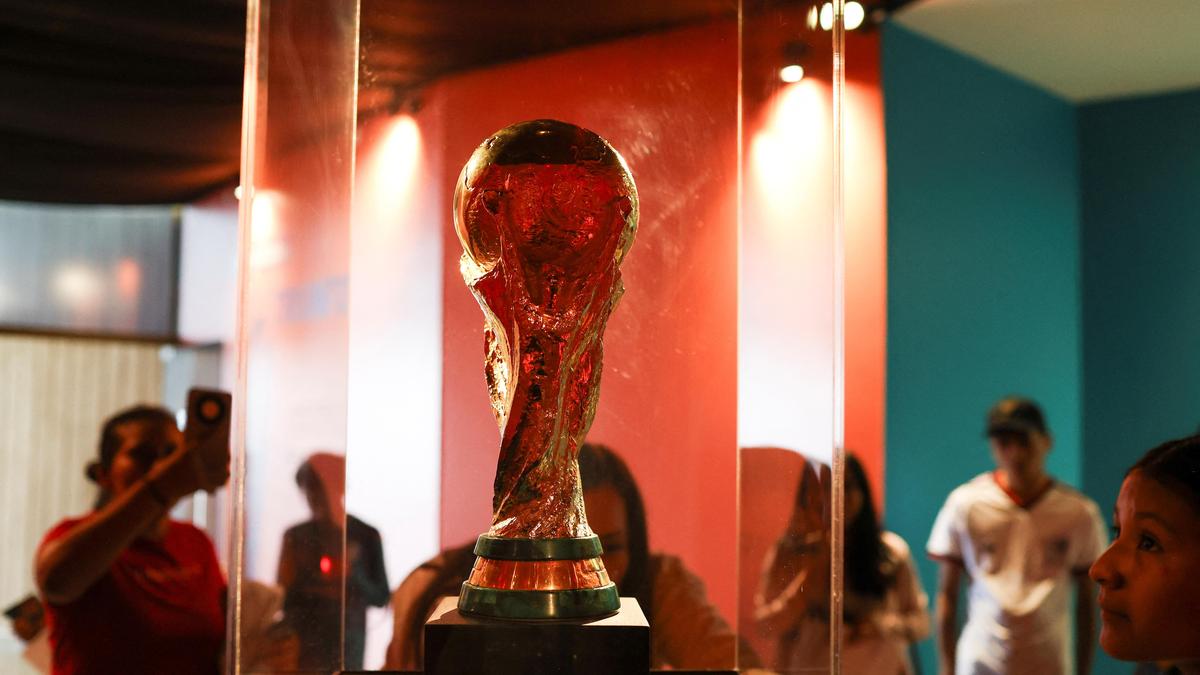
As the countdown begins for the FIFA World Cup 2026, set to be co-hosted by the United States, Canada, and Mexico from June to July, a new trend is taking over social media—AI-generated football anthems. Fans are leveraging artificial intelligence to create mass-produced, viral songs supporting their favorite teams, with these tracks amassing millions of views on platforms like YouTube, TikTok, and Instagram. While official anthems, including one recently released by Shakira, have been commissioned by FIFA, many fans seem to prefer the AI-generated versions, which are quick to produce and tailored to celebrate national teams.
The trend reportedly began in February with “Imbattables,” an AI-generated song dedicated to the French national team. Created by Crystalo, who is listed on Spotify as France’s “premier AI musical creator,” the track opens with a call-and-response listing the names of star players like Kylian Mbappé. Following its success, a Brazilian version emerged, produced by Guilherme Maia, who operates under the artist name M4IA. Maia described using AI to layer different elements together, creating a trending phonk melody. Soon after, similar anthems for teams like Portugal, Argentina, and Germany followed, each adopting the same format—reciting player names before hailing the squad’s “king,” whether it be Cristiano Ronaldo for Portugal or Lionel Messi for Argentina.
Maia acknowledged that the current wave of AI-generated music is more about following trends and recreating emotions rather than pioneering new artistic directions. “What I see happening now is more about people following a trend or trying to recreate a feeling,” he told AFP. While he expressed enthusiasm for AI’s potential in music production, he also raised concerns about authorship and copyright, emphasizing that traditional music rules still apply even when AI is involved. “In music, there are clear rules. You can’t just copy someone else’s work or use samples without permission, even if AI is involved,” he stated.
The use of AI in music creation, however, has sparked debate over attribution and compensation. Jason Palamara, an assistant professor of music technology at Indiana University, highlighted the lack of clarity surrounding how artists are credited when their copyrighted work is used to train AI models. “It had to come from somewhere,” he said, pointing to the murky ethical and legal waters surrounding AI-generated content. Palamara also noted that AI music often lacks the depth and complexity of human-composed pieces, describing it as “one compact product” rather than a layered, textured composition.
Despite these concerns, Morgan Hayduk, co-CEO of music rights software company Beatdapp, suggested that many listeners may not be seeking artistic complexity. “There seems to be a cohort of people who actually don’t care,” Hayduk observed. “They like the music, and they like the back story that it came from a large language model and not a songwriter or a group.” He added that AI-generated music serves a practical purpose, particularly for quick-fix songs that can be chanted by fans or used in advertisements—a clear use case for the technology in its current stage.
The phenomenon has also highlighted inconsistencies in AI-generated content. For instance, a fan-made World Cup song for Portugal was sung with a Brazilian accent, while a Colombian version mispronounced James Rodríguez’s first name in English rather than Spanish. These quirks, while minor, underscore the limitations of AI in replicating cultural nuances and linguistic accuracy.
As the music industry grapples with the rapid rise of AI, the World Cup fan songs represent a microcosm of the broader challenges ahead. Hayduk described the issue as the “thorny Rubicon” the industry must cross, emphasizing the need to understand and regulate generative outputs. With the 2026 tournament on the horizon, the debate over AI’s role in creativity, ownership, and compensation is only set to intensify, even as fans continue to embrace these viral anthems.