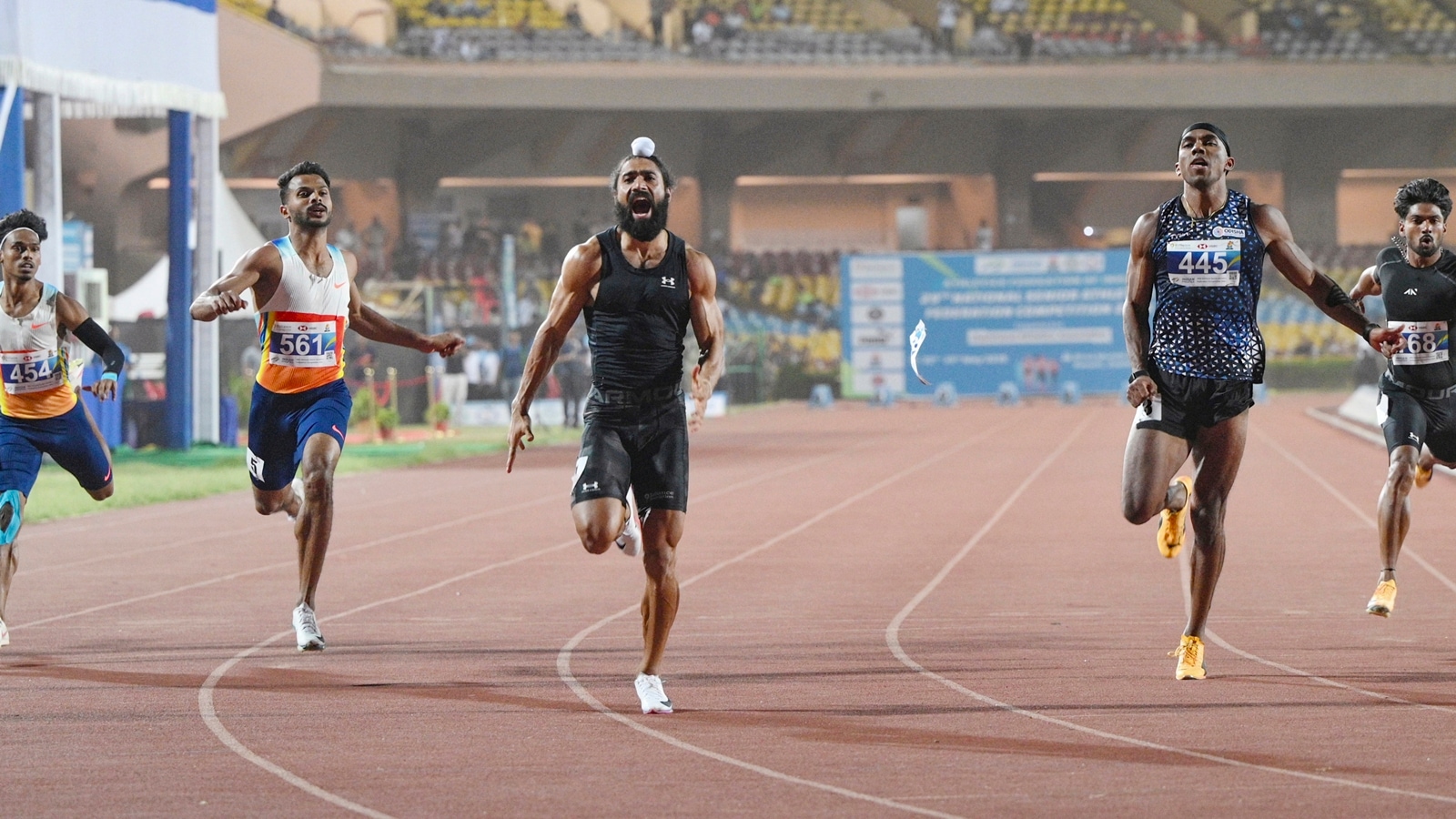
India’s sprint sensation Gurindervir Singh scripted a historic moment at the Federation Cup in Ranchi on Monday, clocking a blistering 10.09 seconds in the men’s 100m final to shatter the national record. The 24-year-old Punjab athlete not only erased the previous mark of 10.15 seconds set by Animesh Kujur just hours earlier but also became the first Indian to break the 10.10-second barrier in the event. His performance sent shockwaves across Indian athletics and sparked nationwide celebrations.
The dramatic sequence unfolded within a span of 24 hours. On the opening day of the tournament, Gurindervir had already broken the national record with a time of 10.24 seconds. However, Animesh Kujur of Jharkhand quickly reclaimed the record with a run of 10.15 seconds. Faced with the pressure of external expectations and media attention, Gurindervir’s coach, Australian James Hillier, took a decisive step. He instructed the athlete to disconnect entirely—no smartphone, no social media, and total focus on recovery. Yet, within a day, Gurindervir’s record-breaking run had gone viral, dominating sports reels and headlines across the country.
In an exclusive interview with *The Indian Express*, Gurindervir opened up about the emotional and mental challenges he faced last year, which had nearly derailed his career. He revealed that hurtful comments about his appearance had deeply affected him. “Someone said something about my appearance, to my face. I was disturbed. I stopped looking in the mirror. I used to look down,” he shared. The criticism eroded his confidence, and he admitted, “I lost a lot of confidence. I can’t tell you what those words were, but they were hurtful.” It was a turning point when coach Hillier stepped in with tough love. “He told me that no one will stand up for me. I will have to stand at the starting line. No one will come to motivate me. I will have to motivate myself,” Gurindervir recalled. Under Hillier’s guidance, he learned to filter noise, ignore negativity, and rebuild his mental strength.
Speaking about his journey from a “bulky” athlete to a leaner, faster sprinter, Gurindervir acknowledged the sacrifices he has made. “I have left everything. I haven’t eaten anything for a long time,” he said, referring to his strict diet and training regimen. While his family enjoys traditional sweets like *pinni* and *Ras Malai*, he avoids them to stay in peak condition. “When I see it, I feel like eating it but can’t due to the dream of becoming a world-class sprinter,” he added.
On the significance of his record, Gurindervir emphasized its potential impact on the next generation. “It might have an impact on the next generation but not on the ones who are already involved in drugs,” he said, highlighting Punjab’s long-standing struggle with substance abuse. He believes his achievement could inspire youth to choose athletics over harmful paths. “This race can tell the next generation which path to choose,” he stated.
Gurindervir also reflected on being a sprinter from Punjab, a state traditionally known for throwers and quarter-milers. “Earlier, there were throwers. There were 400m runners. Now, I have chosen to run 100m and 200m, and I think people will look at me and say that if he can do it, I’ll also do it,” he said, expressing hope that his success will encourage more athletes from the region to take up sprinting.
Looking ahead, Gurindervir remains grounded. “Nothing. Just go back, eat, exercise, train, and repeat,” he said, signaling that his focus is now on sustained improvement and future competitions, including the Asian Championships and World Championships. His coach’s philosophy—self-motivation, discipline, and resilience—has clearly resonated, propelling India’s fastest man into a new era of sprinting excellence.