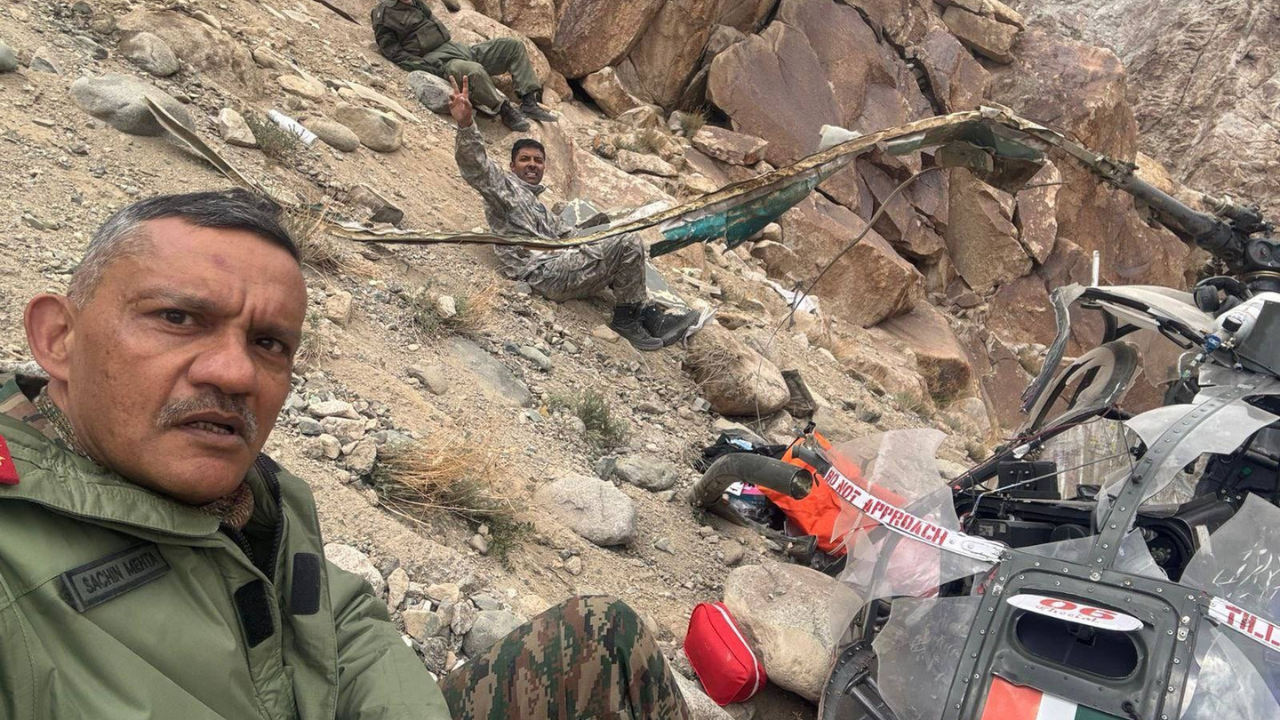
In a dramatic incident, three Indian Army officers, including a Major General, a Lieutenant Colonel, and a Major, escaped with injuries after their helicopter crashed in the mountainous region of Tangste near Leh in Ladakh. The single-engine HAL Cheetah helicopter, which was operated by the Lieutenant Colonel and the Major, went down on May 20 during a flight over high-altitude terrain. The Major General, who commands the 3 Infantry Division, was on board as a passenger.
Fortunately, all three officers were able to walk out of the wreckage on their own, despite sustaining injuries. The incident has raised concerns about the safety of the ageing Cheetah helicopters, which have been in service since 1976. The Cheetah helicopters have been a crucial asset for the Indian Army, particularly in high-altitude and forward regions like the Siachen Glacier. They are used for high-altitude logistics and reconnaissance missions for the armed forces.
The incident has also highlighted the need for the Indian Army to phase out the ageing Cheetah and Chetak helicopters. Over the past decade, more than 15 Cheetah and Chetak helicopters have been involved in crashes, resulting in the loss of several pilots' lives. The Army has planned to replace these helicopters with new-generation Light Utility Helicopters (LUHs) over the next 8-10 years. Hindustan Aeronautics Limited (HAL) is playing a key role in this transition, with the Army already placing orders for six limited-series-production LUHs.
The LUHs, designed to reach a top speed of 220 kmph, a service ceiling of 6.5 km, and an operational range of 350 km, will provide a much-needed upgrade to the Indian Army's aviation capabilities. The new helicopters will be more efficient, reliable, and safer than the ageing Cheetah and Chetak helicopters. The incident in Ladakh has once again highlighted the need for the Indian Army to prioritize the safety of its personnel and invest in modernising its aviation capabilities.
An inquiry has been ordered into the incident, and the cause of the crash is currently under investigation. The incident is a sobering reminder of the risks faced by military personnel and the importance of investing in modern aviation technology. The Indian Army's decision to phase out the ageing Cheetah and Chetak helicopters and replace them with new-generation LUHs is a welcome step towards improving the safety and efficiency of its aviation capabilities.