Researchers at the National Institute of Technology Karnataka (NIT-K), Surathkal, have developed a first-of-its-kind bioactive, mechanically robust, and locally acting anti-microbial coating technology specifically designed for orthopaedic implants used in hip and knee joint replacements. The innovation, which has been granted a patent, represents a significant advancement in indigenous biomedical engineering and is poised to improve patient outcomes for millions of implant recipients both in India and worldwide, NIT-K announced on Wednesday, May 27, 2026.
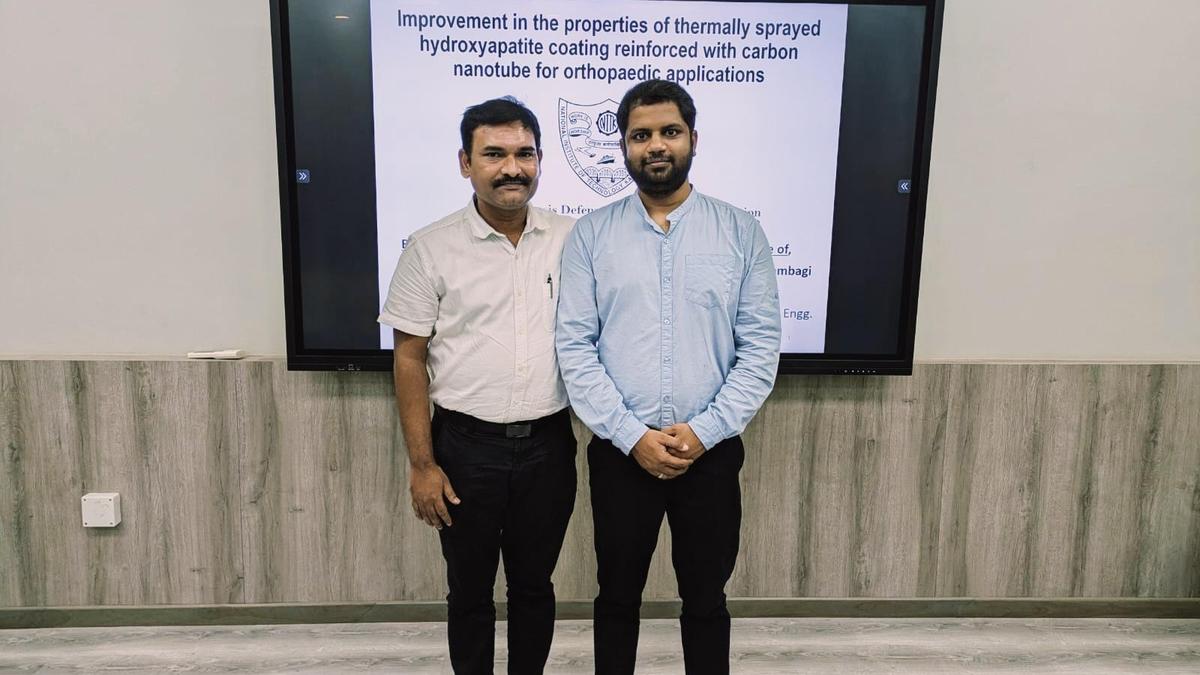
The technology was developed by Associate Professor Sudhakar C. Jambagi from the Department of Mechanical Engineering and his doctoral student Deep Shankar. Shankar completed his PhD under Jambagi’s supervision and has since established and is leading a deep-tech startup established to commercialise the breakthrough technology.
The newly developed coating is engineered as a composite material that can be directly applied onto the surfaces of metallic implants using an optimised High Velocity Oxy-Fuel (HVOF) thermal spray process. This application method ensures strong adhesion and uniform coverage. The coating is designed to provide targeted anti-microbial protection at the implant site, reducing the risk of post-surgical infections caused by bacterial colonisation. At the same time, it enhances the mechanical durability, wear resistance, and coating adhesion of the implant. Crucially, the coating promotes osseointegration—the process by which bone grows and bonds directly to the implant surface—thereby improving the long-term stability and integration of the implant with the patient’s skeleton.
Pre-clinical studies conducted by the research team have shown promising performance compared to conventional implants currently available on the market. The enhanced osseointegration and anti-microbial properties together are expected to substantially reduce the need for revision surgeries, which are often required due to infection, implant loosening, or wear. This not only promises better clinical outcomes for patients but also carries significant implications for reducing healthcare costs and improving overall quality of life for those undergoing joint replacement procedures.
The innovation aligns closely with national priorities under the ‘Make in India’ initiative and supports the Government of India’s vision of ‘Swastha Bharat’ (Healthy India) and ‘Viksit Bharat’ (Developed India) by fostering indigenous biomedical technology development. By enabling the production of advanced, cost-effective orthopaedic implants within the country, the technology aims to make high-quality joint replacement solutions more accessible to Indian patients.
The research findings have been published in multiple international research journals, and the technology has already secured patent protection. The research team is now actively working toward clinical translation and commercialisation, with the patented technology being translated into a dedicated deep-tech startup to bring this solution to market.
Speaking about the breakthrough, Associate Professor Sudhakar C. Jambagi highlighted that implant-associated infections and mechanical failures remain major challenges in orthopaedic surgery. “Our coating technology addresses these issues by combining anti-microbial efficacy with superior mechanical performance and bone integration, offering a comprehensive solution for safer and longer-lasting implants,” he said.
The development underscores NIT-K Surathkal’s growing role in advancing medical technology in India, positioning the institute as a key contributor to the nation’s healthcare innovation ecosystem.