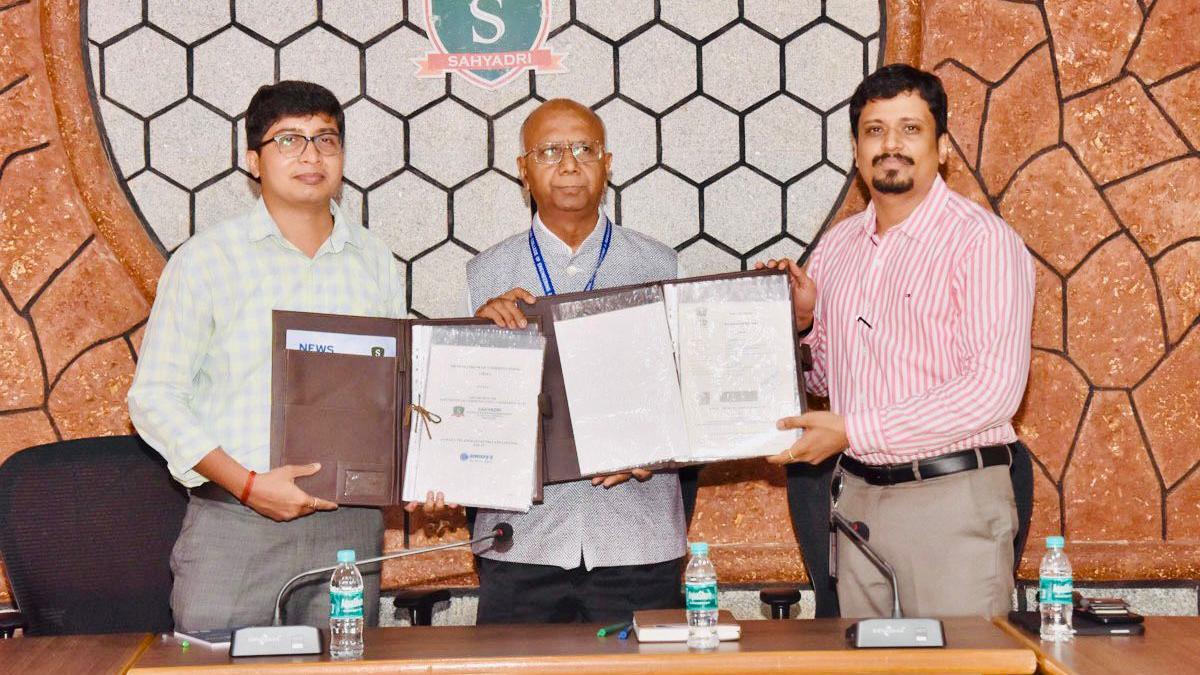
•SCEM, Mangaluru, signed an MoU with Anmaya Technologies to advance semiconductor education and hardware innovation.
•The collaboration focuses on semiconductor technologies, VLSI design, embedded systems, FPGA development, AI hardware acceleration, and edge computing.
•The MoU supports SCEM’s new M.Tech in VLSI Design & Embedded Systems programme and enhances the B.E. in ECE curriculum.
•Anmaya Technologies will provide mentorship, internships, expert sessions, and project-based learning to students.
•SCEM already has a Center of Excellence in VLSI Design supported by Karmic Design Pvt. Ltd.
•The global semiconductor industry is projected to exceed $600 billion, increasing demand for skilled professionals.
•The partnership aims to prepare students for careers in the rapidly growing semiconductor and next-generation hardware innovation ecosystem.
In a significant move to strengthen India’s position in the global semiconductor ecosystem, Sahyadri College of Engineering & Management (SCEM) in Mangaluru has inked a Memorandum of Understanding (MoU) with Anmaya Technologies, a Bengaluru-based deep-tech firm specializing in FPGA-native and embedded hardware solutions. The agreement was formalized recently on the college campus in the presence of S. S. Injaganeri, Principal of SCEM, Anush Bekal, Head of the Department of Electronics and Communication Engineering (ECE), and N. J. Hariprasad, CEO & Founder of Anmaya Technologies. The collaboration aims to equip students with advanced skills in semiconductor technologies, VLSI design, embedded systems, FPGA development, AI hardware acceleration, edge computing, and next-generation electronics.
The partnership comes at a pivotal time as the global semiconductor industry is projected to surpass $600 billion in value, creating a massive demand for skilled professionals across hardware innovation and embedded systems. Through this MoU, SCEM and Anmaya Technologies will jointly create a robust learning ecosystem that combines industry interaction, technical mentoring, internships, expert-led sessions, and project-based learning. These initiatives are designed to prepare students to become integral members of the rapidly expanding global semiconductor workforce. The collaboration will directly support Sahyadri’s newly launched M.Tech in VLSI Design & Embedded Systems programme, while also enhancing the existing B.E. in Electronics & Communication Engineering curriculum by providing hands-on exposure to real-world semiconductor and embedded hardware technologies.
A strong foundation for semiconductor-focused education has already been established at SCEM through the Department of ECE’s dedicated Center of Excellence in VLSI Design, developed with support from Karmic Design Pvt. Ltd. This center serves as a hub for semiconductor-focused learning and industry-oriented skill development. The new partnership with Anmaya Technologies is expected to further expand this ecosystem by introducing advanced expertise in FPGA-native computing, AI acceleration, embedded systems, and high-performance hardware design. Students will gain practical experience in designing and developing next-generation electronic systems, aligning their academic learning with industry requirements.
Under the MoU, Anmaya Technologies will provide technical mentorship and facilitate internships for students, enabling them to work on live projects and gain exposure to cutting-edge tools and methodologies used in the semiconductor industry. Expert sessions and workshops led by industry professionals will be organized regularly, offering students insights into the latest trends and technologies. The collaboration also aims to foster research and innovation in hardware design, particularly in areas like AI hardware acceleration and edge computing, which are critical for the future of electronics and computing.
N. J. Hariprasad, CEO & Founder of Anmaya Technologies, emphasized the importance of such industry-academia partnerships in building a skilled workforce for the semiconductor sector. He stated that the collaboration will help bridge the gap between academic learning and industry needs, ensuring that students are job-ready and equipped to contribute to next-generation hardware innovation. Anush Bekal, Head of the Department of ECE at SCEM, highlighted that the MoU will significantly enhance the department’s capability to offer advanced, industry-relevant programmes and create opportunities for students to engage with real-world challenges in semiconductor technology.
The MoU signing event, held recently at the college premises in Mangaluru, marks a forward-looking step toward strengthening India’s technical education landscape, particularly in high-demand fields like semiconductor design and embedded systems. With the global semiconductor market poised for exponential growth, such collaborations are vital to positioning Indian engineering graduates at the forefront of technological advancements. The partnership between SCEM and Anmaya Technologies is expected to set a benchmark for future collaborations in the deep-tech and semiconductor sectors.