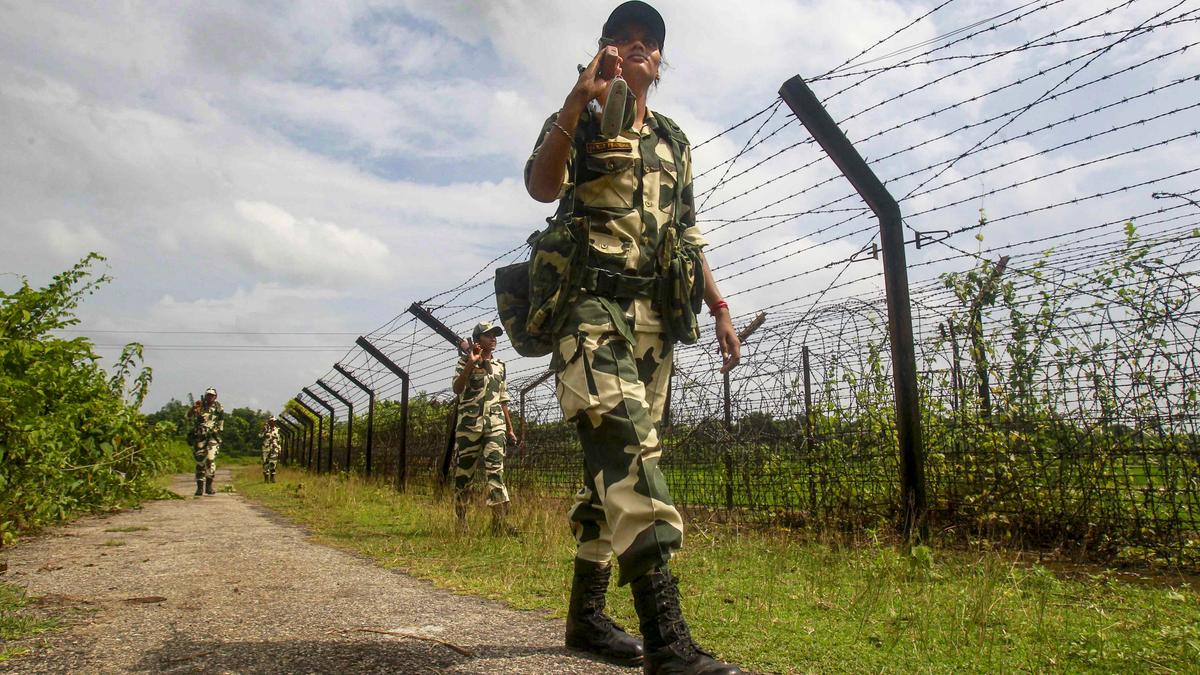
The first round of the biannual Director General-level talks between India and Bangladesh is scheduled to take place in New Delhi from June 8 to 11, government sources confirmed on Sunday. The meeting marks the first high-level border security dialogue since the Bangladesh Nationalist Party (BNP) formed a new government in Dhaka and the Bharatiya Janata Party (BJP) assumed power in West Bengal for the first time. The Directors General of the Border Security Force (BSF) and Border Guards Bangladesh (BGB) will lead their respective delegations in discussions expected to cover a wide range of border-related issues.
The meeting was originally planned for February but was postponed due to the Assembly elections in West Bengal. In the intervening period, Home Minister Amit Shah has conducted extensive visits to forward areas along the Rajasthan and Gujarat borders, highlighting demographic changes and radicalisation as critical security concerns. He is now set to continue his border review with visits to Tripura on June 5 and 6, followed by West Bengal around June 14 and 15, where he will assess border security and hold discussions with officials on infiltration-related challenges.
During the upcoming talks, the BSF is expected to raise several pressing issues. These include trans-border crimes, assaults on BSF personnel and Indian civilians by miscreants based in Bangladesh, the pace of single-row fencing construction, and coordinated action against Indian Insurgent Groups (IIGs) operating from across the border. Official data shows that in 2023, 74 BSF personnel were injured in attacks by miscreants along the Bangladesh border, with the number slightly decreasing to 72 in 2024.
Conversely, the BGB has consistently raised concerns over “illegal push-ins” of individuals into Bangladesh, including Forcibly Displaced Myanmar Nationals (FDMN). In 2024, a total of 1,049 undocumented individuals were apprehended while attempting to enter Bangladesh from India. Interestingly, the BSF reported intercepting over 4,000 undocumented persons in 2025 while they were attempting to leave India through the Bangladesh border—a phenomenon officially recorded as “exfiltration.” According to a government official, while the BSF is instructed not to allow illegal migrants into India, those wishing to leave are not prevented. Their biometrics and personal details are recorded before departure. If such individuals possess identity documents like Aadhaar or PAN cards, authorities are directed to cancel those documents and blacklist their biometrics.
The DG-level talks are held twice annually, alternately hosted by India and Bangladesh, to strengthen cooperation in border management and security. India and Bangladesh share a 4,096-kilometre-long international border, making effective coordination essential. This upcoming dialogue assumes added significance in light of the central government’s new deportation policy, unveiled by the Ministry of Home Affairs (MHA) in March. Under this policy, all states have been directed to set up a special task force in every district to detect, identify, and deport or send back illegal migrants from Bangladesh and Myanmar. States are also required to submit monthly status reports on foreigners who are either missing or overstaying their visas.
The policy update comes against the backdrop of long-standing challenges in securing the India-Bangladesh border. In a written reply to the Lok Sabha on March 3, 2020, Union Minister of State for Home Nityanand Rai acknowledged that some infiltrators manage to enter India through difficult riverine terrain in parts of the border, which are not easily fenced. This acknowledgment underscores the persistent operational difficulties faced by border forces in monitoring and controlling such porous sections.
As the two nations prepare for the upcoming dialogue, the focus remains on enhancing mutual trust, improving intelligence sharing, and addressing both traditional and emerging security threats along one of the world’s most complex and active land borders.