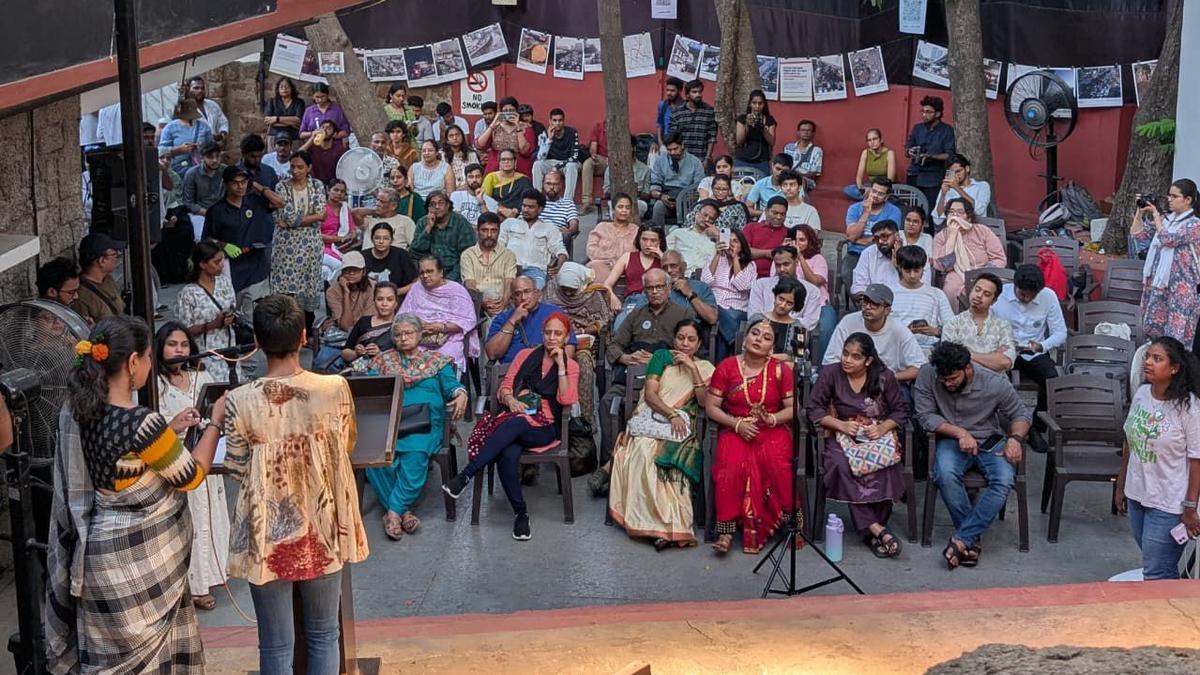
Hyderabad witnessed a significant public discourse on urban mobility and ecological sustainability on Sunday, May 24, 2026, at Lamakaan, where a diverse group of citizens, urban planners, environmental activists, and artists converged for an event titled “Gridlocked: H-CITI, Traffic, KBR and More.” The gathering critically examined the city’s persistent reliance on flyovers as a primary solution to traffic congestion while raising urgent concerns about the environmental toll of infrastructure expansion around the KBR National Park.
The event, which combined a photography exhibition, public discussions, music, and performances, was organized to challenge what participants described as the “flyover myth” in Hyderabad. Organizers emphasized that despite the rapid construction of elevated corridors and flyovers, traffic congestion has continued to worsen, normalizing gridlock as an accepted urban condition. Ambica Srimal, the event organizer, stated that Hyderabad’s traffic situation has deteriorated over the years despite the aggressive pace of flyover construction. She strongly advocated for urban planning that prioritizes people over vehicles, criticizing infrastructure projects that she believes exacerbate congestion rather than alleviate it.
Environmental advocate Kaajal Maheshwari raised concerns about the ecological impact of flyover projects, highlighting how an ecologically important walkway near KBR National Park is being compromised to accommodate flyover infrastructure. Her remarks underscored the tension between urban development and environmental conservation in one of Hyderabad’s most ecologically sensitive areas.
Civil engineer Vijay Mallangi drew international comparisons, citing cities such as Bogotá, Seoul, Amsterdam, Zurich, and Singapore as examples where congestion was successfully addressed without relying heavily on additional flyovers. He argued that Hyderabad could learn from these models, which emphasize integrated public transport, pedestrian-friendly infrastructure, and sustainable urban design.
Urban planner Varun Phadke introduced the ‘3-30-300’ urban planning concept, which promotes having visible trees within 30 metres of homes, achieving 30% neighbourhood canopy cover, and ensuring accessible green spaces within 300 metres. Phadke noted that Hyderabad currently falls short of these benchmarks, with ongoing tree loss due to infrastructure projects undermining the city’s green cover and livability.
The event served as a platform for interdisciplinary dialogue, blending art and activism to challenge conventional urban development narratives. Participants expressed frustration over the lack of visible improvement in traffic conditions despite substantial investment in flyovers. They argued that the city’s infrastructure strategy has disproportionately favoured vehicular movement over pedestrian safety, public transport efficiency, and ecological preservation.
As Hyderabad continues to expand its network of flyovers and elevated roads, the “Gridlocked” event highlighted a growing demand for a paradigm shift in urban planning—one that prioritizes sustainable mobility, ecological balance, and community well-being over short-term vehicular solutions.