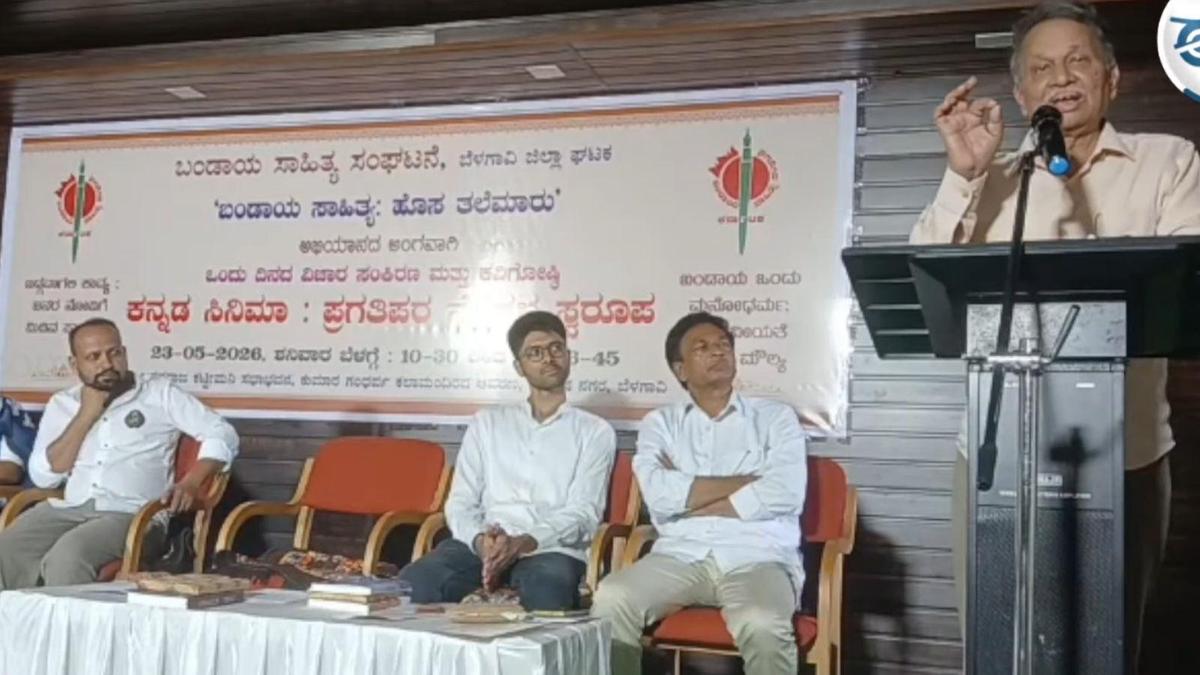
Belagavi witnessed a vibrant discussion on the progressive roots of cinema at a State-level symposium organized by Bandaya Sahitya Sanghatane on Saturday, May 23, 2026. The event brought together writers, filmmakers, poets, and theatre personalities to reflect on how cinema—especially in Kannada—can remain a force for social good while evolving with modern trends.
Renowned writer and director Baragur Ramachandrappa was among the keynote speakers. He emphasized that cinema, unlike literature, is fundamentally a democratic art form that relies on collective effort. “While literature can be deeply individualistic, cinema is a coordinated team effort involving hundreds of people working toward a shared vision,” he said. He applauded recent positive trends in Kannada cinema but cautioned against growing trends that glorify violence, blind beliefs, and divisive propaganda. “Progressive cinema has existed since the early days of Kannada filmmaking—films by legends like Rajkumar and Vishnuvardhan carried strong social messages against casteism, superstition, and injustice,” he noted. He urged young filmmakers to address critical issues such as feudalism, caste discrimination, poverty, gender inequality, and superstitious beliefs, and to create art that fosters peace and harmony.
Filmmaker Vijayakumar M.G., who delivered the keynote address, highlighted how global cinema trends are shaped by audience tastes. Using examples from Iran, Europe, China, and various Indian language cinemas, he argued that public support is essential for meaningful cinema to thrive. “We must ask ourselves: Is the market dumbing us down? Is it refusing to accept the harsh realities of life?” he questioned. He called on audiences to actively support good cinema and provide platforms for emerging filmmakers, stressing that art must reflect life, not just commercial appeal.
Poet Nadeem Sanadi explored the creative relationship between literature and cinema, while Nirmala Battal discussed how mythology has been a rich source of progressive storytelling in Kannada cinema. Vinay Nandihal lamented the loss of progressive themes from modern social films that were once found in mythological cinema. Santosh Nayak pointed out that many filmmakers highlight societal problems but stop short of proposing solutions, leaving audiences without direction.
Theatre personality D.S. Chougale stressed the importance of art connecting with common viewers. “If a piece of art doesn’t resonate with the audience, it has failed its purpose—whether it’s painting, music, film, or theatre,” he said. He cited Marathi works adapted differently in cinema and theatre to illustrate how art forms can reinterpret stories to reach wider audiences.
A poetry recital session added a creative dimension to the event. Sarju Katkar and Rajappa Dalwai participated in the valedictory session. The event was coordinated by Bandaya Sahitya Sanghatane’s district convener Yallappa Himmadi, along with Satish Kulkarni and other members.
As the Kannada film industry grows, the symposium served as a timely reminder that cinema must not only entertain but also inspire, challenge, and unite society toward a more just and inclusive future.