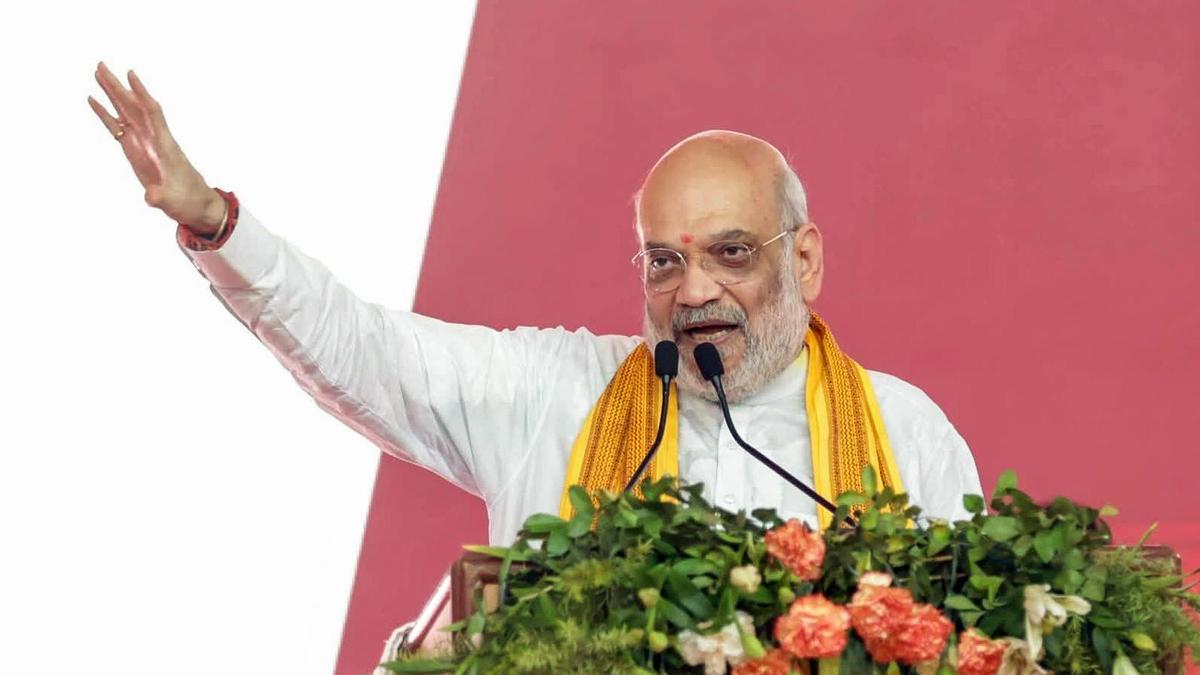
Union Home Minister Amit Shah on May 28, 2026 announced the formation of a high-level committee to investigate “artificial” demographic changes caused by illegal immigration and other unnatural factors, and to determine whether new legislation is required to address the issue. Speaking at an event in Gandhinagar where he inaugurated and laid the foundation stone for development projects worth ₹340 crore, Shah said the committee, led by retired Supreme Court judge Justice Prakash Prabhakar Naolekar, would submit its findings within one year.
The High-Level Committee on Demographic Changes (HLCDC) was constituted by the Union Ministry of Home Affairs on May 27, 2026, in response to what the Centre described as “extensive challenges” arising from demographic shifts driven by illegal immigration. According to a government notification, the panel will examine the root causes behind these artificial demographic shifts across India, deliberate on remedial measures, and assess whether specific legislation is needed to tackle the problem.
Shah emphasized that the central government is committed to identifying and deporting every “ghuspaithiya” (infiltrator) from the country. He stated that Prime Minister Narendra Modi had directed the creation of the committee with this objective in mind. The Home Minister also accused the Trinamool Congress (TMC)-led government in West Bengal of failing to control infiltration from Bangladesh. He claimed that the situation had improved following the state assembly elections, which resulted in the Bharatiya Janata Party (BJP) coming to power in West Bengal.
Highlighting the BJP’s electoral performance, Shah noted that the party now governs 80% of India’s landmass, including a decisive victory in West Bengal where, he alleged, infiltration had been rampant under the previous regime. He pointed out that the BJP had pledged during the election campaign to expedite fencing along the Bangladesh border. Shah praised West Bengal Chief Minister Suvendu Adhikari, stating that within seven days of taking office, the state government had transferred 600 hectares of land to the Border Security Force (BSF) for fencing work. Additionally, he said 121 hectares of land in the Chicken’s Neck (Siliguri Corridor), a critical land bridge connecting northeastern India to the rest of the country, had been handed over to the central government.
The Home Minister cited media reports to claim that some infiltrators were already returning to Bangladesh voluntarily. “Whereas under Mamata’s regime, infiltration used to occur daily,” he said. While detention centers have been established in West Bengal, Shah stated that the state government prefers that illegal immigrants leave the country of their own accord. He assured that if they do so voluntarily, the state government will not file any legal cases against them and will assist in facilitating their departure. Shah expressed hope that a significant number of people would leave before the government initiates a formal identification drive.
The committee includes prominent members such as Census Commissioner Durga Shankar Mishra, former IPS officer Balaji Srivastava, and economist Dr. Shamika Ravi. The Joint Secretary (Foreigners-I) in the Ministry of Home Affairs will serve as the member secretary. Shah also referenced Prime Minister Modi’s Independence Day address on August 15, 2025, in which the Prime Minister had alleged a “premeditated conspiracy” to alter India’s demography through illegal infiltration and announced a “high-powered demographic mission.”
The formation of the committee follows the BJP’s victory in the West Bengal assembly elections, which brought the party to power in the state for the first time. The government has emphasized the need for urgent action to address demographic changes that it claims are being driven by illegal migration, particularly along the Indo-Bangladesh border. The panel’s mandate includes a comprehensive assessment of demographic changes, analysis of abnormal population shifts among religious and social communities, and recommendations for structured, time-bound solutions.